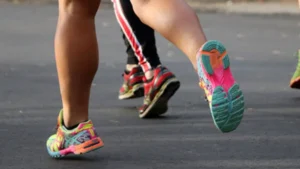

If you’ve ever crossed a finish line limping, spent weeks nursing a nagging knee, or wondered why running feels harder than it should, you’re not alone. The benefits of ChiRunning come from a genuinely different approach to running… one grounded in physics, mindfulness, and decades of practical use. It blends posture, relaxation, alignment, and efficient movement to help runners move with less strain and more ease. For many runners, that means more comfort, more confidence, and a better chance of running well for years to come.
What Is ChiRunning?
ChiRunning is a running technique developed by ultramarathoner and T’ai Chi practitioner Danny Dreyer. After attending a T’ai Chi class in 1999, Dreyer recognized that the principles governing efficient movement in that ancient practice… relaxation, alignment, gravity use, and core engagement… applied directly to running form. He built a system around those principles and ChiRunning was born.
The technique draws on T’ai Chi’s postural alignment, relaxed movement, and use of gravity rather than muscular force.
What makes ChiRunning distinct from conventional running coaching is that it treats form as a skill to be developed progressively, not just a set of rules to memorize. The learning process is intentional, methodical, and cumulative.
Get Started with ChiRunning >>>
The Core Benefits of ChiRunning
1. Dramatically Lower Injury Risk
This is the benefit most runners come to ChiRunning for, and it’s well-supported. Studies suggest that 65% of runners are injured annually. That means in any given year, the odds are better than even that a runner using conventional technique will get hurt.
ChiRunning addresses this directly by changing where the impact goes. Traditional heel-striking sends force up through the ankle, shin, knee, and hip with every stride. ChiRunning promotes a midfoot strike that lands directly beneath the body’s center of gravity, spreading impact more evenly and reducing the peak force on any single joint.
The specific conditions ChiRunning is known to help reduce or eliminate include:
| Condition | Why ChiRunning Helps |
|---|---|
| Shin splints | Reduced overstriding and heel impact |
| IT band syndrome | Better hip alignment and relaxed leg swing |
| Runner’s knee | Midfoot strike reduces knee loading |
| Plantar fasciitis | Less repetitive stress on the foot and arch |
| Hip pain | Core engagement stabilizes the pelvis |
| Lower back pain | Upright posture and forward fall reduce spinal compression |
| Hamstring strain | Core-driven propulsion takes load off the posterior chain |
The underlying logic is straightforward: if your core is doing the stability work, your legs don’t have to. When your legs are relaxed and your alignment is sound, tissue stress drops significantly.
READ MORE: Safely return to running after injury without getting hurt again
2. Greater Running Efficiency Through Gravity
One of the most counterintuitive things about ChiRunning is its use of gravity as a propulsion tool. The technique involves a slight forward fall from the ankles (not the waist), which allows gravity to initiate forward momentum. Your legs then lift and fall beneath you rather than pushing off aggressively behind you.
This shift changes the muscular equation entirely. Instead of relying on the quads, calves, and hamstrings to drive you forward with every step, you’re allowing physics to do more of the work. The result is that the same pace requires less muscular effort… which means:
- Less fatigue over long distances
- Faster recovery between runs and after races
- More energy remaining in the final miles of a long run or race
For anyone training for a half marathon, marathon, or ultramarathon, this efficiency gain compounds significantly over thousands of steps.
3. Core Strength as a Running Foundation
In conventional running, the core is often an afterthought. Runners are told to “engage your core” without much explanation of why or how. ChiRunning puts the core… specifically the deep stabilizing muscles around the lumbar spine and pelvis… at the center of every stride.
In T’ai Chi, this area is called the “dantien,” and it functions as the body’s energetic and physical center. In ChiRunning, activating this core column creates a stable axis around which everything else can relax. When your trunk is stable, your arms, legs, and shoulders don’t need to compensate with tension. Relaxation at the periphery becomes possible because the center is doing its job.
The practical effect is that ChiRunning doubles as a core-strengthening practice. Consistent training in the technique tends to build functional core stability that carries over into daily life, not just running.
4. A Mindful, Meditative Running Experience
This benefit often surprises people who come to ChiRunning purely for injury prevention. The technique requires continuous internal attention. You’re monitoring your posture, your forward fall, your foot placement, your breathing, and your level of muscular tension all at once. That level of focused presence turns a run into something closer to moving meditation.
This practice of internal monitoring has a name in ChiRunning: “body sensing.” It’s the habit of noticing what’s happening inside your body in real time, catching early warning signs of discomfort before they become injuries, and making small adjustments on the fly.
The mental benefits this produces include:
- Reduced stress and anxiety through present-moment focus
- Greater enjoyment of running, because you’re engaged rather than grinding through miles
- Improved proprioception (your sense of where your body is in space)
- A calmer nervous system after runs, rather than the agitated fatigue some runners experience
Many practitioners describe ChiRunning as the point where running stopped feeling like a chore and started feeling like something they genuinely looked forward to.
“I expected ChiRunning to make me fitter and faster. I didn’t expect it would make running more fun. Probably the biggest change, and the most unexpected change, has been the mental one. Running has become a form of meditation.”
— Cat T.
5. Long-Term Running Longevity
Perhaps the least-discussed but most important benefit of ChiRunning is what it does for your ability to keep running as you age. Most runners accept that their knees will eventually give out, that running is a young person’s sport, or that they’ll need to switch to cycling or swimming in their fifties and sixties. ChiRunning challenges that assumption directly.
Because the technique prioritizes joint-friendly mechanics over raw output, it is specifically designed to reduce the cumulative wear that forces runners off the road over time. Runners who adopt ChiRunning often report:
- Being able to continue running well into their sixties, seventies, and beyond
- Returning to running after injury with better form than before
- Reduced post-run soreness that previously made them dread consecutive training days
For runners over 50, or anyone who has had a significant running-related injury, ChiRunning offers a path back to the sport that doesn’t require pretending the past didn’t happen. It meets you where you are and builds from there.
Read more about Injury-Free Running >>>
Who Benefits Most from ChiRunning?
ChiRunning is not exclusively for one type of runner. The technique has demonstrated value across a wide spectrum:
- New runners are attracted to it because it makes running feel more accessible and less punishing from the start. Learning good form before building bad habits is far easier than unlearning those habits later.
- Experienced runners use it to break through injury cycles, improve economy, and extend their competitive years.
- Runners returning from injury find that ChiRunning gives them a framework for understanding why they got hurt and how to move differently going forward.
- Older runners benefit from its emphasis on longevity, joint protection, and the meditative qualities that make consistent training more sustainable.
That said, it’s worth being honest: ChiRunning is a skill, and skills take time to develop. If you’re looking for an instant fix or a quick performance boost, you may find the learning curve frustrating at first. The technique rewards patience and consistency over shortcuts.
What Does the Learning Process Actually Look Like?
This is the question most resources skip, and it matters enormously for setting realistic expectations.
ChiRunning is typically taught in a progressive, layered way. Early sessions focus on posture, the forward fall, and midfoot landing. Core engagement and arm swing are added over time. Advanced work addresses cadence, breathing, hills, and speed. Most practitioners report that the basic principles start to click within a few weeks of focused practice but integrating them fully into automatic running form can take several months to a year of consistent effort.
This is not a limitation… it’s a feature. The gradual nature of the learning process means you’re building real neuromuscular change, not just adjusting a checklist. That depth is what makes the benefits stick long-term.
Frequently Asked Questions
Is ChiRunning suitable for complete beginners who have never run before?
Yes, and it may actually be the ideal starting point. Learning ChiRunning from scratch means you’re building efficient habits from day one rather than spending years undoing ingrained patterns. Many beginners find that ChiRunning makes those early weeks far more comfortable and enjoyable than conventional running approaches.
How is ChiRunning different from barefoot running or minimalist running?
Both barefoot running and ChiRunning promote a midfoot or forefoot strike and discourage overstriding, so they share some mechanical goals. The key difference is that ChiRunning is a complete technique system… it addresses posture, core engagement, leading with your upper body, arm swing, breathing, and mindset, not just foot placement. You can practice ChiRunning in conventional running shoes. Barefoot running focuses primarily on footwear and foot strike.
Can ChiRunning help if I’ve already been injured?
It’s specifically designed with injury recovery and prevention in mind. Many practitioners came to ChiRunning after dealing with chronic shin splints, IT band syndrome, or knee pain that conventional training approaches hadn’t resolved. That said, if you’re currently injured, working with a qualified ChiRunning instructor alongside any medical care you’re receiving gives you the best chance of a complete recovery and a lasting form change.
Will ChiRunning slow me down while I’m learning it?
In the short term, yes, some runners experience a temporary dip in pace as they focus on form rather than effort. This is normal and expected. As the technique becomes more integrated, most runners find their efficiency improves to the point where they’re running at similar or faster paces with noticeably less effort. Think of it like learning to swim properly… the early awkwardness gives way to something that feels genuinely easier.
How do I find a certified ChiRunning instructor?
Nationally Certified ChiRunning Instructors go through a formal training and certification process through the ChiRunning organization. To find an instructor near you >>>

About the Author
Vince Vaccaro
Vince Vaccaro is a Master ChiRunning®/ChiWalking® Instructor and owner of ChiLiving, ChiRunning, and ChiWalking. Certified since 2005 and trained personally by Danny Dreyer and Chris Griffin, Vince has spent decades helping runners and walkers move with greater ease, less effort, and fewer injuries.
An avid runner for more than 40 years, Vince has completed dozens of marathons and ultramarathons, including Ironman events in Chattanooga, Louisville, and New York City. Based in New Hampshire, he coaches individuals and small groups and teaches workshops throughout the United States.