

If you’ve stumbled onto ChiRunning or ChiWalking and thought “this sounds interesting, but where do I even start?”… you’re not alone. Both methods were developed by Danny Dreyer and draw from Tai Chi principles to make movement feel more natural, sustainable, and injury-free. The right answer to “which one is right for me?” isn’t the same for everyone… and that’s exactly what this guide is here to help you figure out.
Key Takeaways
- ChiRunning vs ChiWalking share the same Tai Chi-based foundation, but ChiWalking is lower-impact and easier to learn for most beginners.
- About 70% of runners experience injury at some point, and ChiRunning’s midfoot landing and forward fall technique are specifically designed to reduce that risk.
- ChiWalking is considered safe for virtually everyone, including people recovering from injury, older adults, and those new to structured movement practice.
- ChiRunning requires more precise technique than ChiWalking… starting with ChiWalking first builds the core awareness and posture habits that make ChiRunning easier to master.
- You don’t have to choose one permanently… many people use ChiWalking and ChiRunning together depending on the day, their energy, and their recovery needs.
What ChiRunning and ChiWalking Actually Have in Common
Both ChiRunning and ChiWalking are built on the same core idea: your body already has what it needs to move efficiently, and the goal is to stop fighting gravity and start using it. Both methods emphasize a tall, aligned posture from head to ankle, active core engagement, and a relaxed, non-forceful approach to movement. Neither method is about pushing harder… both are about moving smarter.
The shared principles include:
- Posture-first movement: You lead with your upper body and core, not your hips or pelvis.
- Gravity-assisted propulsion: A slight forward fall allows gravity to do the forward work, reducing the muscular effort your legs have to generate.
- Relaxed peripheral muscles: Your arms, shoulders, and legs stay relatively soft while your core does the stabilizing.
- Mind-body awareness: Both methods ask you to pay attention to what your body is doing in real time… this is where the Tai Chi influence is most obvious.
Understanding this shared foundation matters because it means the skills you build in ChiWalking directly transfer to ChiRunning. They aren’t two separate systems… they’re two expressions of the same movement philosophy at different speeds.

What Makes ChiWalking Different
ChiWalking is the gentler entry point into this movement philosophy. Most people walk by leading with their pelvis, letting their hips thrust forward and their heels strike the ground hard with each step. ChiWalking flips this pattern by teaching you to lead with your upper body, engage your core, and let your foot land more softly beneath you.
ChiWalking is considered safe for virtually everyone. That includes people who are new to structured exercise, those returning from injury, older adults looking for a low-impact daily movement practice, and anyone who simply wants to walk farther with less fatigue and joint stress.
The learning curve is gentler than ChiRunning because walking gives you more time between steps to feel what your body is doing. You can make corrections, slow down, and tune in to your alignment without the added intensity of running pace. This makes it an excellent place to develop the postural awareness and core habits that both methods share.
ChiWalking is also a legitimate standalone practice… it is not just a “starter” method you graduate out of. Many people practice it for years and find it meets all their movement, fitness, and mindfulness goals without ever needing to run.
ChiWalking benefits for beginners are especially notable around posture and joint health. If you currently experience knee, hip, or lower back discomfort when walking, a ChiWalking technique correction can often address the root mechanical cause rather than just managing symptoms.

What Makes ChiRunning Different
ChiRunning takes the same posture-first, gravity-assisted principles and applies them at running speed, which changes the demands on your body significantly. The technique adds a more pronounced forward fall, a midfoot landing, and a higher cadence (more steps per minute at a lighter effort) to reduce impact forces and distribute load more evenly through the body.
ChiRunning injury prevention is one of the most frequently cited reasons people seek out this method. The statistic that roughly 70% of runners experience injury at some point isn’t just a number… it reflects how poorly most people have been taught to run. ChiRunning addresses the mechanical root causes of common running injuries: overstriding, heel striking, and relying too heavily on the leg muscles to generate forward momentum.
The midfoot landing running technique promoted in ChiRunning is worth understanding specifically. Rather than landing on your heel (which sends a shock wave up through your knee and hip) or your forefoot (which overloads your calves and Achilles), a midfoot strike lands beneath your center of gravity and disperses impact more evenly. For most runners, this is the most injury-preventive way to land.
ChiRunning is more technically complex than ChiWalking, and that complexity matters. The forward fall, in particular, requires genuine core strength and proprioceptive awareness to execute safely. Done incorrectly, it can shift stress rather than reduce it. This is why working with a certified ChiRunning instructor… at least initially… is strongly recommended for anyone serious about making the transition.
A Practical Decision Framework: Which One Is Right for You Right Now?
Here is where most content stops short: it tells you what each method is, but doesn’t help you decide. Below is a body-aware, situation-specific guide.
Start with ChiWalking if…
- You are new to structured exercise or returning after a long break
- You are recovering from a running injury, joint surgery, or chronic pain
- You are over 60 and want a sustainable, low-impact daily movement practice
- You currently experience discomfort when walking (knees, hips, lower back)
- You want to build core awareness and postural habits before adding running intensity
- Running feels inaccessible or unappealing right now… ChiWalking is a complete practice, not a consolation prize
Start with (or transition to) ChiRunning if…
- You are already running but dealing with recurring injuries or fatigue
- You want to run longer distances or at a faster pace without more effort
- You have tried conventional running form cues and they haven’t helped
- You are willing to slow down and relearn your form from the ground up
- You have good baseline core strength and body awareness
Use both if…
- You alternate run/walk intervals and want both to feel efficient
- You are building back from injury and use ChiWalking on recovery days
- You want your active recovery or cool-down walks to feel intentional and restorative
- You simply enjoy both and find that each meets a different need on different days
Situation | Recommended Starting Point |
New to exercise | ChiWalking |
Recovering from injury | ChiWalking |
Active runner with recurring injuries | ChiRunning (with instruction) |
Older adult seeking low-impact movement | ChiWalking |
Runner wanting efficiency and speed gains | ChiRunning |
Run/walk interval training | Both |
Mindfulness and stress reduction focus | ChiWalking |
The Progression Path: Moving from ChiWalking into ChiRunning
One of the most underexplored aspects of these two methods is how naturally ChiWalking prepares you for ChiRunning… if and when you want to go there. This isn’t a rigid requirement, but it is a genuine advantage.
When you practice ChiWalking consistently, you develop:
- Core engagement as a habit, not something you have to consciously activate
- Body sensing and postural awareness of where your body is in space
- A relaxed upper body that doesn’t tighten under physical effort
- Sensitivity to your foot strike and how different landings feel
These are precisely the skills ChiRunning builds on. Transitioning to ChiRunning after several weeks or months of ChiWalking practice often feels more intuitive than jumping into ChiRunning cold.
The chi running form tips that instructors most commonly give to beginners… “create a column – align your body”, “relax your shoulders”, “don’t reach forward with your foot”… are all things ChiWalking practice quietly reinforces long before you pick up speed.
A sensible progression might look like this:
- Weeks 1-4: Focus exclusively on ChiWalking technique. Get comfortable with the posture, core engagement, and upper-body lean at a walk.
- Weeks 5-8: Introduce short ChiRunning intervals within your ChiWalks. Walk for 4-5 minutes, run with ChiRunning form for 1-2 minutes, repeat.
- Weeks 9+: Gradually extend your ChiRunning segments as your form feels consistent and your body responds well. Keep ChiWalking as a complement, not a replacement.
A ChiRunning or ChiWalking workshop is a great way to learn the technique with a master instructor as your guide. There is also more than one way to learn ChiWalking, depending on what fits your situation.
How to Know When You’re Not Ready for ChiRunning Yet
When to start ChiRunning is as much about listening to your body as it is about reaching a fitness milestone.
Signs you may want to stay with ChiWalking a little longer:
- Your core fatigues quickly during basic walking practice
- You find it difficult to maintain an upright posture when walking for more than 10-15 minutes
- You are still managing pain, swelling, or restricted range of motion from a past injury
- You cannot yet feel the difference between a midfoot landing and a heel strike at a walk
- Running currently causes you pain… this is a signal to address form at a lower speed first
None of these are permanent. They are simply honest signals that your body needs more foundation before adding the demands of running speed and impact.
The Mindfulness Dimension: Why This Choice Is Also About What You Need Mentally
The ChiWalking vs walking technique comparison often focuses on the physical… posture, foot strike, efficiency. But there’s a real mental and emotional dimension to this choice that’s worth naming.
ChiWalking is inherently meditative. The pace is slower, the attention is inward, and the practice encourages a quality of presence that is harder to access when you’re pushing a running pace. For many people, especially those dealing with high stress, anxiety, or recovery from illness, ChiWalking offers something that no amount of running intensity can… a way to feel genuinely restored by movement rather than just depleted in a “good” way.
ChiRunning, by contrast, can become deeply meditative too… but it usually takes longer to get there. In the early stages of learning ChiRunning form, there’s enough conscious attention required that the meditative quality often develops after the technique becomes more automatic.
If your goals include stress reduction, reconnecting with your body after a difficult period, or simply enjoying movement without performance pressure… ChiWalking may serve you better regardless of your fitness level.
A Note on the Forward Fall Running Technique
The forward fall running technique is often misunderstood, and it’s worth clearing up because it’s central to ChiRunning and also relevant to ChiWalking at higher effort levels.
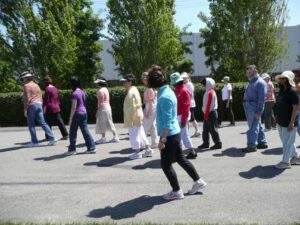
Leading with your upper body is not a bend at the waist. It is a whole-body tilt from the ankle, with the body remaining straight from head to heel. Think of a ski jumper in flight… the entire body is angled forward as one unit, not folded in the middle.
This distinction matters because bending at the waist is one of the most common errors beginners make when trying to apply the ChiRunning fall. It looks similar but actually increases lower back strain rather than reducing it.
The appropriate degree of fall also varies with speed. At a walk, the forward fall is very subtle. At a faster run, it increases slightly. A forward fall is never exaggerated… it is calibrated to exactly the speed you’re moving at, so gravity is doing the work without your legs scrambling to keep up.
Frequently Asked Questions
Is ChiWalking better for seniors than regular walking?
ChiWalking offers specific advantages for older adults because it reduces heel-strike impact, encourages better spinal alignment, and actively engages the core… all of which support joint health and balance. That said, any new movement practice should be introduced gradually, and anyone managing specific health conditions should check with their healthcare provider before starting.
Do I need a certified instructor to start ChiWalking?
You can begin exploring ChiWalking through books, videos, and workshops without a one-on-one instructor, and many people do. However, working with a certified instructor… even for a single session… is valuable because common form errors (like bending at the waist instead of falling from the ankles) are difficult to self-diagnose. For ChiRunning especially, instruction is strongly recommended.
Can I do ChiRunning if I’ve had knee surgery?
This depends entirely on the nature of your surgery, your recovery timeline, and your surgeon’s clearance for running activities. ChiRunning’s midfoot landing and reduced impact forces are generally considered gentler on the knees than conventional running form, but “gentler” is not the same as “appropriate for post-surgical return.” Start with ChiWalking first, get medical clearance before reintroducing running of any kind, and work with a certified instructor who can adapt the technique to your specific situation.
How long does it take to learn ChiRunning properly?
Most people begin to feel the difference in their running form within a few weeks of focused practice, but truly ingraining the technique… to the point where it feels automatic rather than effortful… typically takes several months of consistent work. The forward fall and midfoot landing in particular require reprogramming movement habits that may have been in place for years or decades. Patience and gradual progression are more effective than trying to overhaul everything at once.
What shoes work best for ChiRunning and ChiWalking?
Both methods tend to work well with lightweight, flexible footwear that allows you to feel your foot landing and doesn’t push you onto your heel with an elevated heel drop. Highly cushioned, motion-control shoes with significant heel elevation can work against the midfoot landing you’re trying to develop. That said, shoe choice is individual, and a certified instructor or specialty running store fitting can help you find options that support your specific foot type and biomechanics.

About the Author
Vince Vaccaro
Vince Vaccaro is a Master ChiRunning®/ChiWalking® Instructor and owner of ChiLiving, ChiRunning, and ChiWalking. Certified since 2005 and trained personally by Danny Dreyer and Chris Griffin, Vince has spent decades helping runners and walkers move with greater ease, less effort, and fewer injuries.
An avid runner for more than 40 years, Vince has completed dozens of marathons and ultramarathons, including Ironman events in Chattanooga, Louisville, and New York City. Based in New Hampshire, he coaches individuals and small groups and teaches workshops throughout the United States.